Categories
Blog

Putting on a Show – Week 10: Funny – what is it and how do we? (Part 2)

We had a read/singthrough of the whole play at the weekend. It’s all very exciting. And now, the second part of William Breden’s article on the funny. WARNING: contains many swears.

Part 2: Lowering the tone – rude words are big and clever

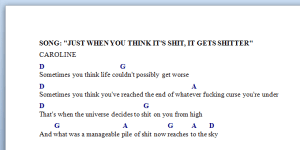
music screenshot

Last week I focused on a specific joke and used it to show something about the play as a whole. This time around I want to be a bit broader and talk about tone.

The tone for the original 5-10 minute version of Nando’s was pretty straightforward: silly. Because it was over a short space of time there was no desperate need for character development and/or a narrative arc. It started silly and got sillier. It was funny. All good.

Once the decision to go to an hour was reached then tone became a bit more of an issue. One level, one note of emotion, over such a period would be stupid and it would be boring. Boring is bad.

So instead there are ups and downs, laughs and sads, anger and calm. We achieve this through dialogue and song, and also through swearing.

Categories
Blog

Putting on a Show – Week 9: Funny – what is it and how do we? (Part 1)

nandos miniThis week and next, William Breden tells us all about funny business.

Part 1: Why did the chicken change her name?

For the last couple of weeks (prior to the ominous death clock last week, I mean), James has held forth about the music in Nando’s, and how it evolved and why it does what it does. That’s fine, music is generally held to be of at least moderate importance in a musical after all. Whatever.

This week, I thought I’d focus on humour in Nando’s, how it’s evolved as the play developed and what purpose it serves.

A good example is a joke that was present from the first draft, back in April, and has remained until now, our tenth draft:

FENUGREEK

Hello! Hello and welcome. You both look swell, just swell. My name is Sally Chicken.

                        (She pauses to allow a reaction from the couple)

All Nando’s employees must change their names to Chicken when they join.

MELVIN

Erm. Right.

CAROLINE

Wow.

FENUGREEK

Ha! I’m only joking. HAAAA! Could you imagine?

CAROLINE

Ha, no.

FENUGREEK

It’s not Sally, it’s Fenugreek.

Now, that’s not a particularly complex joke, but it helps achieve a few things. Firstly, it introduces the character of Fenugreek and establishes that a) she’s got a silly name and b) she has a somewhat idiosyncratic syntax. This helps the play in that it immediately sets up contrast between her and the rather straight Melvin and Caroline, and in this contrast we can begin to find absurdity, drama and humour. All from a small exchange of silly lines. Neat, huh?

But there’s a little problem with being too smug about the above, namely that the punchline, the ‘Fenugreek’ , isn’t actually particularly amusing. I liked it at the time, I thought it was a funny word and appropriate and so hoped it would fit but on hearing it rehearsed and then performed it fell flat. It wasn’t funny. I wasn’t funny. Disaster. So how do we try to make something that we thought was funny funnier?

We tinker.

This is how the line appears in the current draft:

RUBBER

Ha! I’m only joking. Could you imagine?

CAROLINE (Still giggling)

Ha! No.

RUBBER

Of course it’s not Sally, it’s Rubber.

So it’s the same exact joke but the payoff is better, clearer, more logical. Logic is important in humour, and you can subvert it but if you want a silly chicken name then by Colonel Sanders you’d better go with a rubber chicken, which has been a stalwart of comedy since at least the Pythons.

The new version of the joke was performed and I had a number of people after the event come to me and tell me they liked it (which was nice) and one person come to me and tell me they liked everything except the name change (which I also welcomed, critical feedback is vital). So not everyone will laugh, hopefully more people will than won’t, but even if they don’t it still serves an important role in establishing tone.

So, jokes are funny (sometimes, to some people) but that isn’t always their most important role.

Next week I’ll talk a bit more about how humour affects the tone of Nando’s, and also talk about swearing.

Categories
Blog

Knee Socks #fridayflash

#fridayflash, wordbunches every Friday. Now made with at least 25% recycled material. This week’s prompt is “inspired by a song released in 2013”.

#fridayflash 2013-09-20

It’s just turned midnight and I am missing you like mad.

Categories
Blog

Putting on a Show – Week 8: Something Chicken…

…this way flaps.

November 12th, 2013.

Categories
Blog

Stranded #fridayflash

#fridayflash, wordbunches every Friday. Now with Soundcloud readings and guests. This week’s prompt is “arriving somewhere unexpected”.

Send me your own #fridayflash piece – details at the bottom (under the read more).

#fridayflash 2013-09-13

Dear darling,

My dear, dear darling, I write to you in most perilous circumstances. My adventure has turned to misadventure. That is to say, the expedition in the rainforest has gone terribly awry. We ventured mistakenly from the main river and into a narrow creek, which lead directly to rapids and a waterfall, which would of course splinter my boat and my bones. In my enthusiasm to escape this fate, I snapped my oar clean in two. In the end, we had to rapidly abandon the boat, with what little supplies I and my guide could carry, and swim to shore.

Categories
Blog

Putting on a Show – Week Seven: The Breden Interrogation (Act Two)

The only update since last time is that we did a readthrough, and the words sound like words. So that’s nice. The last five “questions” from Will Breden to myself concerning music and musicals and such:

Categories
Blog

Tech Support #fridayflash

New #fridayflash for you all. Wordbunchings every Friday(ish).

#fidayflash 2013-09-06

The Internet isn’t working again.

Categories
Blog

Putting on a Show – Week Six: The Breden Interrogation (Act One)

v10 screenshotSorry there was no blog last week. Not only did Bank Holiday delight but confuse us all, but we were in intense work on the script. On August 30th we hit version 10.0, with all songs written and words as we want them. Now, we abandon writing it for a bit. We’re giving it to our actors and close friends for feedback, then we’ll bring it back into the shop to tinker with it again based on what they think. The big day, though, is September 29th, when we’ll have our read/singthrough with the cast, and where we really find out if this script’s going to work.

But, blogging. This week and next, some terse questions from Will Breden to myself, concerning music and musicals. The first part:

Categories
Blog

What I Did on My Holidays #fridayflash

Introducing #fridayflash, and its attendant unironic hashtag. New wordbunchings every Friday. Feel free to join in. Rules are your own.

#fridayflash 2013-08-23

What I did on my summer holidays

This summer, we headed for a fortnight in the south of France. This was a dreadful mistake.

Categories
Blog

Putting on a Show – Week Five: A Sneaky Peek

script screenshot

This week, rather than just babble on about the play, we thought we’d share a small chunk of it. Here is a bit of the latest draft, from the beginning of Act Two. Our characters are Caroline, who is waiting in Nando’s for her boyfriend to join her, and the waitress, Rubber. Our action begins with some mild language:

Categories
Blog

Putting on a Show – Week Four: Melvin

MelvinWelcome back to our series on Nando’s and Nandon’ts. Last week, you heard James Bloomfield talking about his role, Melvin, and this week you’ll hear myself and Will.

Melvin’s been the most difficult character to crack, and has certainly been the one under most discussion in the super-secret writing meetings. Our protagonist has always been Caroline, and as such is closely linked with the story, so the two progress hand in hand. The waitress, Miss Chicken, arrived pretty much fully formed, and is distinct enough that she slots in naturally to whatever plans we have.

Melvin, however, is different. When the play was short, and the focus was on the couple’s interaction, he slotted easily into the “boyfriend” role. However, as the play got longer, and Rubber was brought more into the story, he slipped quite strongly into becoming the antagonist. We could make him very clearly one or the other, but we felt that would be simplistic and unsatisfying. So, most of the trouble has been to reconcile both sides of his character, while trying to a real person rather than a function of plot.

How this difficulty in balance has come out in the script is that you’d have some scenes in which Melvin was being boyfriend-y, and then some scenes in which he was small-minded, rude, and just an arse, and you had no idea what Caroline would see in this guy. It is important that you buy them as a couple, and to some extent you want them to figure out a way past their problems. There had to be some tension as to who Caroline would end up with, but also there had to be some sympathy with Melvin’s plight, otherwise there would be no drama. It was also important structurally – to buy the ending of the second act, you have to believe in Melvin and Caroline as a couple.

Our specific thoughts concerning motivation (rather than what seemed funny and to make some sense) only truly coalesced for all the characters following our performance at the Y Theatre. An email from me on June 24th contains this nugget of Melvin motivation:

“…Melvin realises she’s never going to be the sort of girl he wants to be in a relationship with…”

Will succinctly defines his position in the play:

“…Caroline’s story,  Rubber waxes as Melvin wanes”

And on the 30th, Will sent me a bio about him, to inspire further script development:

Melvin:

Age: 24

From: Leicester

Job: British Gas telesales (shifts)

Friends: Work mostly, male mostly, locals.

Notes: Confident but prone to anger. More comfortable in mainstream culture than with subtlety. Caroline is not his first serious partner. He compartmentalises his life. Work/relationships/friends. Is genuinely fond of Caroline.

The only amendments I made to this were that he is “the sort of person who tries to figure out the plots to movies as he goes along,” and I describe him at the end leaving “Malvolio-style/like the antagonist of a high school comedy”.

So now, Melvin’s function in the play is a lot clearer. Yes, he is Caroline’s boyfriend, but they are wrong for each other. This makes him the antagonist, but that doesn’t necessarily make him a bad person. His outbursts stem from an emotional place –  frustration about his relationship – rather than him being a dick, and they are simply his way of dealing with their issues. He doesn’t get on with the waitress, but that doesn’t mean he’s misanthropic, just that their personalities don’t gel. His solo is yet to finalised, but it’s now more about himself than attacking other people.

It’s worth pointing out that however aggrieved Melvin is, as his relationship with Caroline goes up and then down, and though he blames Rubber for some of his woes, he doesn’t descend into something too unpleasant. We have a setup where both of the female characters in the play are bisexual but Melvin doesn’t seek to make emotional capital over this.

Obviously, the character will continue to evolve, as we have yet to hand the script to James to see what he can do with it, but we’re coming to a better place with him, which is satisfying.

Next week, we’ll look at the music.